Walls that keep their clean original finish year after year
Clean walls restored to original colour
Red Calima silt, soot, and atmospheric dirt lift away entirely from rendered surfaces and stone cladding. External walls regain their bright, uniform tone without the blotchy patches caused by uneven spot washing.
Intact render free from pressure damage
Low-pressure softwashing lifts deep grime without eroding protective paint coats or pitting lime plaster. Decorative mouldings and silicone expansion joints remain sealed against coastal weather.
Damp elevations protected against mould
Targeted biocidal treatments eliminate biological spores lodged deep within shaded wall sections. Treated surfaces resist rapid regrowth through prolonged periods of coastal humidity and winter damp.
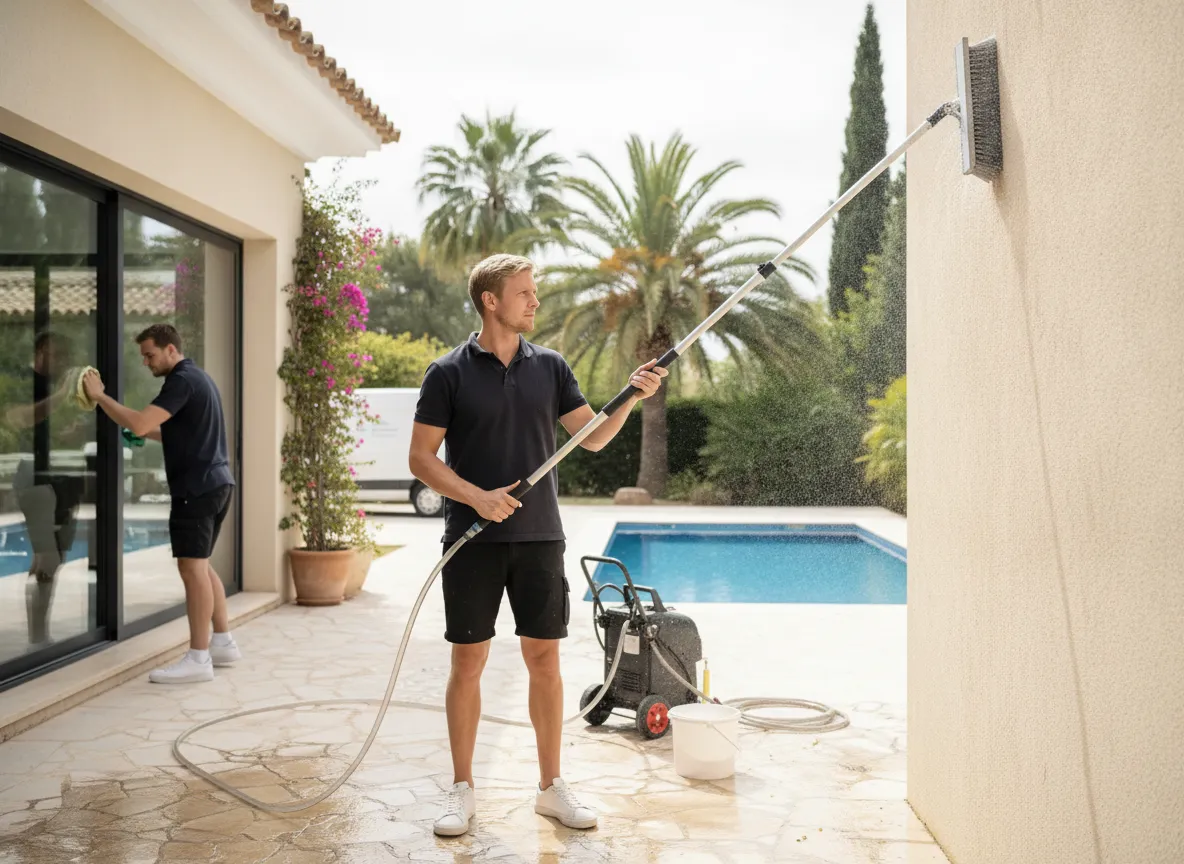 Facade cleaning in the Costa del Sol
Calima dust settles into porous monocapa render and bakes solid under intense summer heat. Leaving mineral sand on southern elevations turns faint red haze into permanent discoloration. Pressure washing cannot lift this staining without gouging the plaster.
Shaded north walls along the coast trap winter damp, spreading green microalgae and black mould across paintwork. Damp biological growth eats into exterior coatings, forcing an expensive full repaint instead of simple routine maintenance.
Salt air near the sea binds atmospheric grime directly to exterior stone trim and render joints. Delaying treatment causes lime plaster to blow and paint layers to flake away, leaving surfaces exposed to heavy seasonal rain.
How the cleaning process runs from start to finish
Walls and joints are thoroughly checked — Masonry, painted render, and stone mouldings are inspected for cracks before water application. Identifying unstable plaster beforehand prevents moisture from entering behind the wall envelope.
Surrounding garden beds are shielded — Sensitive landscaping, outdoor lighting, and electrical fixtures receive waterproof protective coverings. Soil around the perimeter is pre-soaked with fresh water to safeguard root systems against any runoff.
Specialist detergent is applied — Biocidal wash solutions are sprayed evenly across elevations at low pressure. The mix breaks down embedded Calima dust, fungal spores, and salt deposits without stripping the surface.
Active solution is left to dwell — The cleaning agent remains on the wall just long enough to lift deep organic growth and mineral grime. Keeping the surface damp throughout this stage prevents chemical drying under the sun.
Elevations are rinsed with low pressure — Treated walls are washed down using temperature-controlled warm water at minimal pressure. Low force preserves delicate render texture, lime plaster, and silicone movement joints intact.
Algae inhibitor is applied to damp sections — North-facing elevations and recessed architectural features receive a dedicated anti-microbial barrier treatment. This residual wash inhibits the return of green algae and black mould over winter.
Exterior windows and frames are washed — Window panes, metal tracks, and downspouts are cleaned completely of residual runoff as part of window cleaning. Terraces are rinsed clean of all washed-down debris.
We cover the Costa del Sol
Exterior facade washing covers substantial detached properties and private villa grounds across the coastal corridor.
Your questions, answered
Why is softwashing preferred over high-pressure jetting on render? +
High-pressure washing forces water behind monocapa render, shears exterior paint from the substrate, and pits natural sandstone. Low-pressure softwashing breaks down algae and mineral dirt chemically. Grime lifts cleanly while keeping the underlying wall surface undamaged.
How does the wash remove fine red calima sand? +
Calima dust consists of fine mineral particles that bind to exterior paint under strong ultraviolet light. Specialist surface-active detergents dissolve these electrostatic bonds. The fine red silt rinses away freely with warm, low-pressure water without scouring the wall surface.
Will the cleaning chemicals damage garden plants around the villa? +
Mature gardens receive dedicated protection before work starts. Beds are pre-soaked with clean water and covered with protective sheeting. Everything is rinsed again once work finishes.
How often does an exterior villa facade need cleaning? +
Most detached villas require comprehensive wall washing once every 12 to 24 months. Properties with heavy northern exposure usually benefit from an annual post-winter wash before intense summer heat sets in.
Can multi-storey villas be washed safely without heavy scaffolding? +
Most multi-level elevations are reached safely from ground level using carbon-fibre extension lances. These deliver wash solution up to four storeys high. For taller towers or steep hillside plots, mobile cherry pickers are utilized without fixing anchors into walls.
Are windows and terraces left clean after the wash? +
Facade cleaning carries runoff down over glass and surrounding perimeter paving. Glass panes, window joinery, and adjacent terrace slabs are rinsed down with pure water as the final step. No mineral streaks or chemical spots remain on the surfaces.
What happens if patches of algae or staining remain visible after drying? +
Surfaces are checked after drying completely. If any patches, stains, or missed corners remain visible, report them promptly. The affected areas are washed again until the finish matches expectations.